
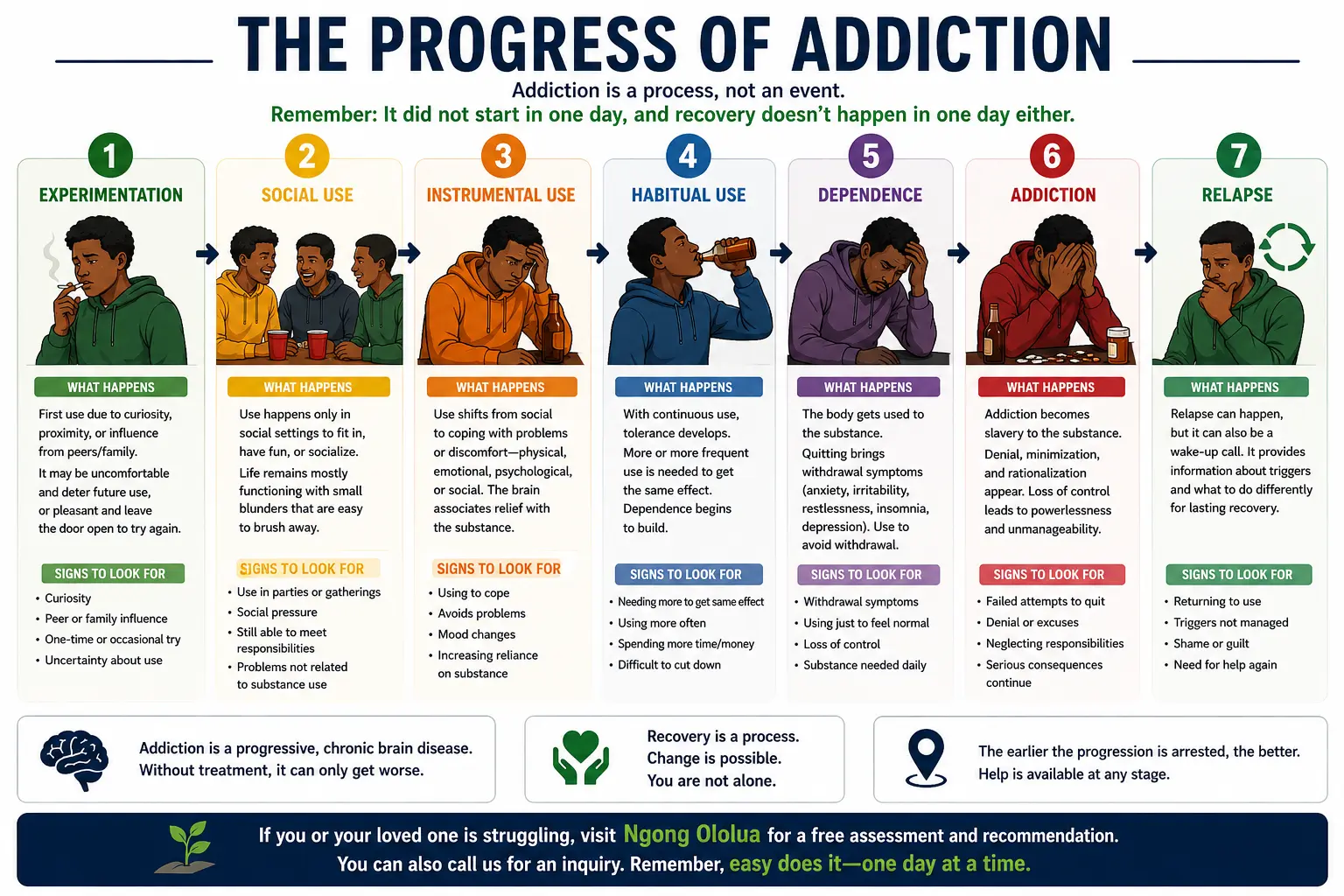
STAGES OF ADDICTION
There is a famous saying in recovery circles: “Remember, addiction did not start in one day, so remember—easy does it.” The saying reminds us that just as addiction develops over time, recovery also takes time. Lasting change rarely happens overnight.
Consider someone who tries smoking a cigarette for the first time. They may experience a hacking cough, an unpleasant metallic taste, and enough discomfort to swear they will never smoke again. Yet some return to try again—this time more cautiously, hoping for a different experience or trying to prove a point. If the experience is rewarding in some way, whether through pleasure, acceptance by peers, or temporary relief from stress, the behaviour is more likely to be repeated.
This pattern is not unique to cigarettes. It can occur with alcohol, other mind- and mood-altering substances, and even certain behaviours such as gambling. For some individuals, the very first experience is pleasurable, and when factors such as availability, peer influence, stress, or genetic vulnerability are present, progression toward addiction may occur more rapidly.
Understanding these stages is important because addiction is progressive. The earlier it is recognized, the easier it is to intervene before severe consequences develop. While every person’s journey is unique, many people move through recognizable stages before developing addiction, and even after recovery they remain vulnerable to relapse.
Stage 1: Experimentation
Experimentation is the first encounter with a substance or addictive behaviour. It often occurs because of curiosity, availability, or influence from peers, family members, or the surrounding environment.
For many people, the first experience is unpleasant enough to discourage future use. Others, however, experience pleasure, excitement, or relief, making them more open to trying it again. Among teenagers especially, experimentation may continue despite negative consequences because of peer pressure, curiosity, or the desire to fit in.
At this stage, early education and supportive conversations can often prevent further progression.
Stage 2: Social Use
During social use, substances are used primarily in social settings. The individual may drink alcohol at parties, celebrations, or gatherings as part of social interaction rather than out of necessity.
Alcohol has often been referred to as a “social lubricant” because it lowers inhibitions and may make conversations feel easier. For many people, this stage lasts for years without obvious signs of addiction.
The length of this stage varies depending on several factors, including the substance being used, availability, employment, social environment, genetics, and personal vulnerability.
Although the person generally remains functional, occasional poor decisions or embarrassing incidents may occur. However, most life problems are still unrelated to substance use.
Stage 3: Instrumental Use
A significant shift occurs during instrumental use.
Instead of using substances simply to socialize, the individual begins using them to cope with life. They may drink to manage stress after work, use drugs to escape emotional pain, or rely on substances to deal with loneliness, anxiety, grief, or psychological distress.
Gradually, the brain begins to associate relief with the substance. Whenever uncomfortable emotions arise, the individual increasingly turns to the substance rather than developing healthy coping strategies.
Over time, this reduces the person’s ability to face life’s challenges without using, increasing the risk of progressing to compulsive use.
Stage 4: Habitual Use
As substance use becomes more frequent, it gradually turns into a habit rather than an occasional choice.
At this stage, tolerance begins to develop. Tolerance refers to the progressive physical and psychological adaptation of the body and brain to a substance, causing its effects to become less noticeable over time.
Because the original amount no longer produces the desired effect, the individual often begins using larger quantities or using more frequently without fully recognizing how much their consumption has increased.
The development of tolerance is an early indicator that physical and psychological dependence is beginning to emerge.
Stage 5: Dependence
With continued use, the body and brain adapt so extensively that the individual begins to need the substance simply to feel normal.
Stopping becomes increasingly difficult because withdrawal symptoms begin to appear. These may include anxiety, irritability, depression, insomnia, restlessness, sweating, tremors, or other physical and emotional discomforts depending on the substance involved.
Instead of using to experience pleasure, the person increasingly uses to avoid withdrawal symptoms.
At this point, the substance is no longer merely a choice—it has become part of everyday functioning.
Professional support during this stage can significantly improve the chances of successful recovery.
Stage 6: Addiction
The word addiction originates from the Latin word addictus. In ancient Rome, it referred to a debtor who was legally handed over into servitude because of unpaid debts.
The term captures the reality of addiction well: the individual gradually becomes enslaved to the substance.
Denial, minimization, and rationalization often become more pronounced. Even when people recognize that their substance use is causing serious problems, they frequently feel unable to stop despite repeated attempts.
The person experiences increasing powerlessness over their use and growing unmanageability in different areas of life, including relationships, finances, work, education, and physical and mental health.
Without treatment, addiction is generally progressive, meaning the consequences continue to worsen over time.
Stage 7: Relapse
Relapse is one of the characteristics commonly associated with addiction. While relapse is not inevitable, many people seek treatment after experiencing one or more relapses.
Importantly, relapse should not be viewed as failure. Instead, it can provide valuable information about triggers, coping skills that need strengthening, and unresolved issues that continue to place recovery at risk.
Many people achieve lasting recovery after learning from previous relapses and making different choices with the support of treatment, recovery communities, family, and healthy coping strategies.
Recovery remains possible at every stage.
Final Thoughts
Addiction is a progressive, chronic brain disease. Left untreated, it generally becomes more severe over time. The encouraging news is that progression can be interrupted at any stage, and the earlier intervention occurs, the better the outcomes are likely to be.
At Sober Homes, we believe that early assessment and timely intervention save lives. Depending on the stage of addiction, treatment may involve education, counselling, outpatient support, family interventions, or residential rehabilitation.
If you or someone you love is struggling with alcohol, drugs, or other addictive behaviours, we encourage you to seek help. Visit Sober Homes, Ngong Ololua, for a free assessment and professional recommendations, or contact us to learn more about the treatment options available.
Remember: Addiction is a process—but so is recovery. With the right support, recovery is possible.
Ready to Take the First Step?
Speak with one of our addiction professionals for a confidential, free assessment.